

Unfortunately, there are no properties on your watch list.
Do you have a question? Leave your contact details here and we will call you back!


Press Release
REALOGIS: Absence of large-scale lettings slows Munich’s logistics and industrial property market in H1 2026
- Take-up fell by 18% to 115,700 sq m
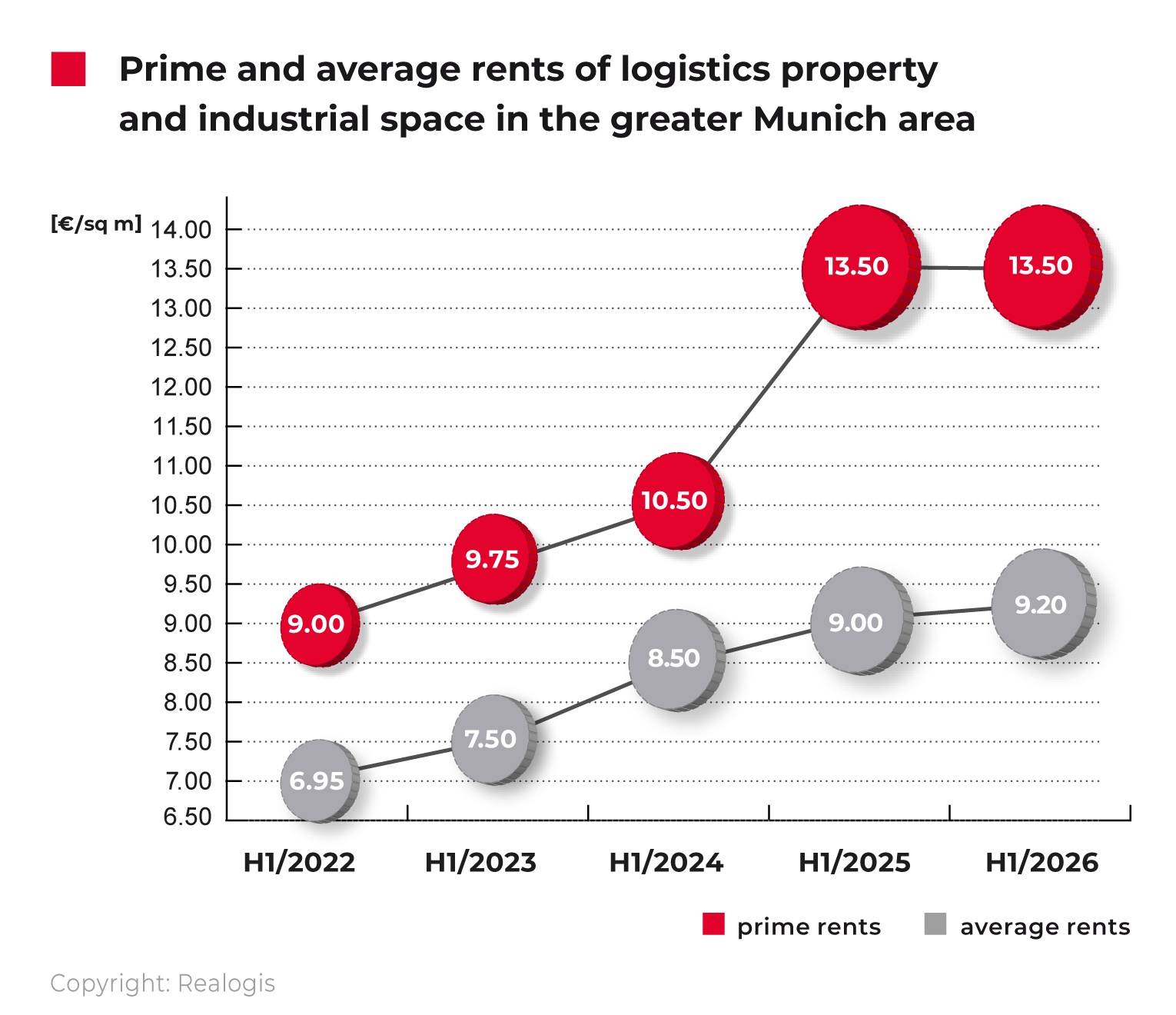
- Prime rent remained at a record level of €13.50/sq m
- Existing properties dominated with a 77% market share
- Manufacturing was the strongest sector
- No lease transaction above 10,000 sq m
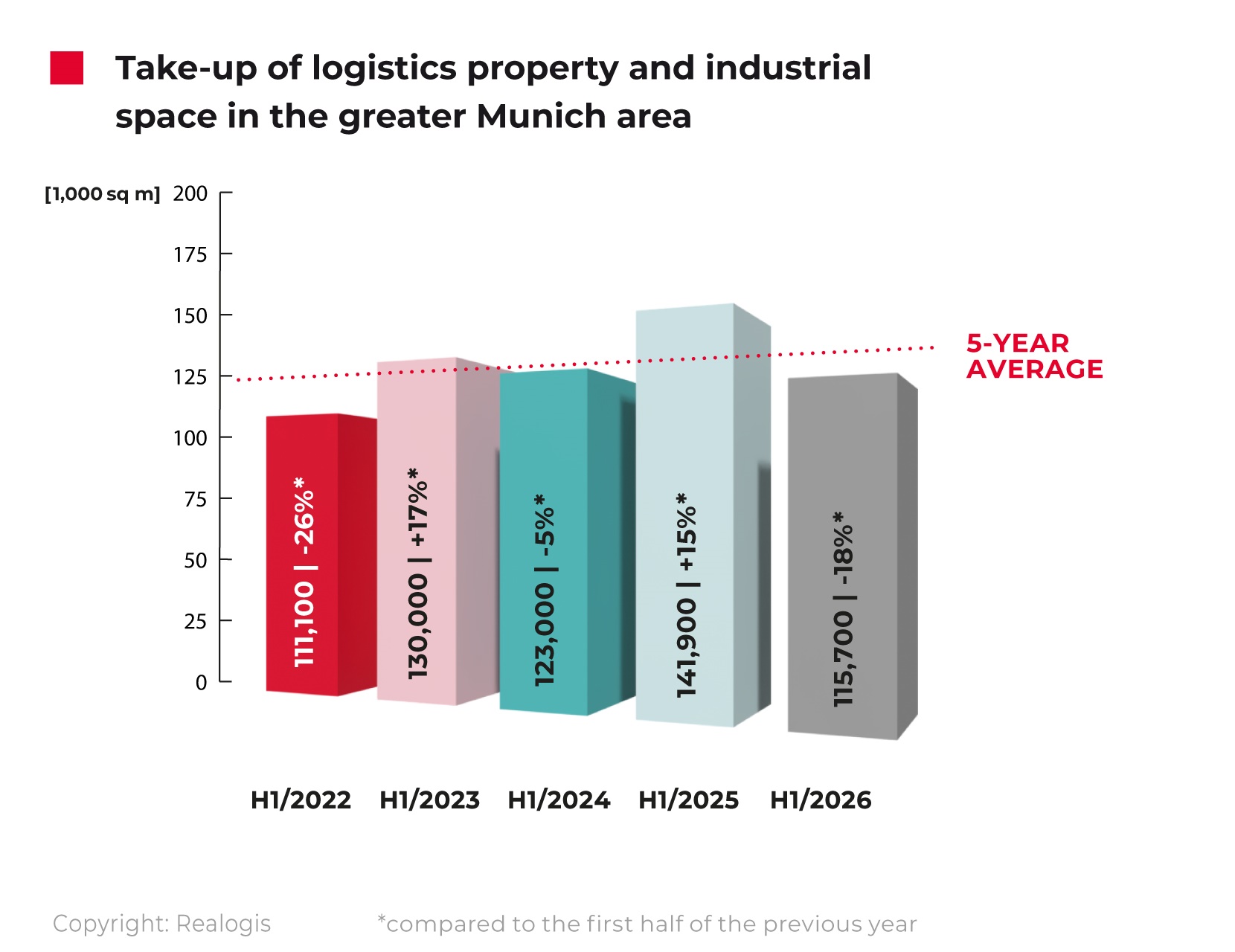
Compared with the strong first half of 2025, this represents a decrease of 26,200 sq m or 18% (H1 2025: 141,900 sq m). The five-year average of 124,340 sq m was missed by 7%. The three largest lease transactions, by Schletter Group, ARX Robotics and Logline express, together accounted for 22% of the result.
Nicolas Werner, Managing Director of REALOGIS Immobilien München GmbH, comments: “I expect market activity to pick up noticeably in the second half of the year. On the one hand, companies from the defence sector are looking for space in the Munich region. On the other, several large deals are already in the pipeline.”
Prime rent stable, average rent continues to rise
Prime rent remained unchanged at €13.50/sq m in H1 2026, staying at the level recorded in the same period last year and at year-end 2025. It had previously risen continuously since 2022. The current figure exceeded the five-year average for first-half periods of €11.25/sq m by 20%. Average rent increased moderately by 2% to €9.20/sq m (H1 2025: €9.00/sq m), placing it around 12% above the five-year average of €8.23/sq m.
Existing properties dominate as greenfield developments fall sharply
Lettings in existing properties dominated the Munich market in H1 2026. They accounted for 88,800 sq m or 77% of total take-up. Compared with the same period last year, this represents an increase of 9,800 sq m or 12%. New builds on former brownfield sites contributed 24,000 sq m or 21% to total take-up, down by 8,600 sq m or 26% compared with H1 2025.
New builds on greenfield sites played only a minor role. After 30,300 sq m or 21% in the same period last year, take-up in this segment fell by 27,400 sq m or 90%. Only 2% of total take-up was attributable to this category. This decline was the main reason for the weaker overall market result. Munich’s logistics and industrial property market remained a purely rental market in H1 2026.
By building type, other properties that were assigned neither to big-box spaces nor to business parks led the market. They reached 68,700 sq m or a 59% market share, an increase of 24,500 sq m compared with the same period last year. Business parks followed in second place with 32,600 sq m. Big-box spaces fell from first to third place and contributed only 14,400 sq m or 13% to take-up (H1 2025: 66,500 sq m / 47%).
Munich’s north region remains ahead but declines significantly
Munich’s north region remained the strongest region by take-up, with 57,300 sq m or a 49% market share (H1 2025: 94,400 sq m / 67%). In a regional comparison, however, the north was the only region to record a decline in take-up. The decrease amounted to 37,100 sq m or 39%. The two headline deals by ARX Robotics and Logline express accounted for 27% of take-up in Munich’s north region.
The eastern region again ranked second with 31,900 sq m or 28%, slightly exceeding the level recorded in the same period last year of 30,100 sq m. The largest lease transaction of the first half of the year, concluded by Schletter Group for 9,440 sq m, contributed 30% to regional take-up. Munich’s west region remained in third place with 15,000 sq m or 13% and missed its five-year average of 19,800 sq m by 24%. The southern region ranked last with 11,500 sq m or 10%, but increased by 5,100 sq m or 80% compared with the same period last year.
Manufacturing takes the top position
Manufacturing was the only sector to record an increase in take-up, taking the top position on Munich’s logistics and industrial property market in H1 2026. Having ranked third in the same period last year, the sector increased its take-up from 23,500 sq m to 61,700 sq m and achieved a market share of 53%. This also included two of the three largest lease transactions of the first half of the year, by Schletter Group and ARX Robotics, which together accounted for 17,440 sq m of leased space.
Logistics/Distribution again ranked second with 39,700 sq m or 34% (H1 2025: 50,900 sq m / 36%). Despite a decrease of 11,200 sq m or 22%, the five-year average of 33,160 sq m was exceeded by 20%. The Supply/Others category ranked third with 7,900 sq m or 7%. Retail/Wholesale, still the strongest sector in the same period last year, fell to last place with 6,400 sq m or 6%. Compared with H1 2025, this represents a decrease of 51,300 sq m or 89%. The absence of large-scale lease transactions in traditional retail was the main reason for this development.
Large-scale lease transactions absent as mid-sized segments gain ground
No lease transaction was recorded in the size band of 10,001 sq m and above in the first six months of 2026. In the same period last year, this segment had still led the market and accounted for 54,400 sq m or 38% of total take-up. Units between 5,001 sq m and 10,000 sq m moved into first place with 40,400 sq m or a 35% share of take-up. This represented an increase of 8,400 sq m or 26%. The five-year average of 26,660 sq m was exceeded by 52%.
Medium-sized to larger units between 3,001 sq m and 5,000 sq m followed in second place with 36,900 sq m or 32%. This size band recorded the strongest increase in both absolute and percentage terms. The result was more than twice as high as the current five-year average of 18,320 sq m. Smaller units between 1,000 sq m and 3,000 sq m reached 30,400 sq m or 26%. Small units below 1,000 sq m played a subordinate role with 8,000 sq m or 7%.
Key figures at a glance
- Take-up: 115,700 sq m
- Prime rent: €13.50/sq m
- Average rent: €9.20/sq m
- Existing properties: 88,800 sq m | New build on brownfield sites: 24,000 sq m |
- New build on greenfield sites: 2,900 sq m
- Tenants: 115,700 sq m | Owner-occupiers: 0 sq m
Press contact REALOGIS:
TARGA Communications
Jochen Goetzelmann and Arne Degener
Tel: +49 (151) 196 933 90
E-Mail: realogis@targacom.de
Company contact REALOGIS:
REALOGIS Holding GmbH
Silja Schuppler
Marketing Manager
Leopoldstraße 154, 80804 Munich
Phone: +49/89/51 55 69 17
E-mail: s.schuppler@realogis.de
www.realogis.de
REALOGIS. The No. 1 in industrial and logistics real estate
The REALOGIS Group is Germany's leading address for consulting and brokerage services for industrial and logistics real estate as well as commercial properties. As an owner-managed company with offices in Berlin, Düsseldorf, southern and northern Germany, Frankfurt am Main, Hamburg, Leipzig, Munich and Stuttgart, the company, founded in 2005, has in-depth market knowledge and more than twenty years of experience in the German real estate sector.
Around 70 employees support national and international companies from the logistics, industrial, retail and e-commerce sectors, as well as private and institutional investors. The range of services includes finding tenants for existing and new-build properties, supporting investors with acquisitions and project developments, advising on property searches or sales, and developing and implementing holistic real estate strategies, from location analysis to the utilisation of assets no longer required for business operations.